Use coupon code:
 Something exciting is coming soon – stay tuned to find out! 🚀✨

- « Previous blog
-
Comparison
-
Oct 20, 2026
-
Oct 26, 2026
-
20608
-
0
- Next blog »
FooEvents and WP Event Manager are two well-known WordPress plugins for running events, and online event management keeps changing fast. FooEvents is a ticket-selling plugin built on WooCommerce. It lets you sell tickets for in-person, virtual and hybrid events from your own store.
WP Event Manager covers much more of the job. You can list events, show them on a calendar, take registrations, ticket selling, host virtual events and promote all of it from one plugin. Over 30,000 organizers run their events on it today. If you get stuck, the support team will help you out. Let's look at why so many of them chose WP Event Manager over FooEvents, and what makes it one of the best event plugins on WordPress.
FooEvents vs WP Event Manager: Overview
FooEvents is mostly about tickets and bookings.
WP Event Manager is a full WordPress event management plugin that runs the rest of your event site too. Even the free version comes with event listings, a submission form for organizers, search filters and an organizer dashboard. Need more? There's an add-on for nearly everything else. FooEvents' range is smaller: ticketing, bookings, seating, attendee details, a calendar and check-in apps. Its core plugin also isn't free. It costs $99 a year, while the WP Event Manager core is free on WordPress.org.
FooEvents vs WP Event Manager: Get an Attractive and Engaging Event Calendar with WP Event Manager
On most event sites, the calendar is the page people open first. So it has to look nice, keep visitors interested and be simple to click through.
You'll find shortcodes and widgets in the calendars of both plugins. FooEvents Calendar shows events in a calendar or a list. The WP Event Manager Calendar add-on also has quick calendar access. Move your mouse over a date and you'll see the main details of the event without opening another page. On the listing page, people can filter events to find the right one. With the iCal add-on, they can add any event to their Google Calendar.
FooEvents vs WP Event Manager: Get More Event Management Services with WP Event Manager
With WP Event Manager, you get everything for an event in one package, starting with the listing and ending with check-in at the door. FooEvents is mainly for selling tickets and handling bookings and attendee details.
FooEvents has 8 paid extensions:
- Bookings: Customers select a date and time slot and book it on your site, which is suitable for classes, venues and services.
- Seating: Allows you to add seating to your events so purchasers can choose their seats.
- Point of Sale: For printing and selling tickets in person at the door or in the box office.
- Custom Attendee Fields: Create your own attendee fields at checkout.
- PDF Tickets: Attach tickets and booking confirmations as PDFs.
- Multi-day: sells tickets for events that run over more than one day.
- Calendar: shows your events in a calendar on your WordPress site.
- Express Check-in: speeds up check-in at the venue.
It also offers free Check-ins apps, Ticket Themes and FooEmail.
WP Event Manager has more than 40 premium add-ons in four groups, and you can buy each one on its own:
- Calendar: View your events in a beautiful and easy to use calendar.
- Recurring Events: Automatically adds recurring events to your calendar and maintains them up to date.
- iCal: Lets visitors add your events to Google Calendar.
- Google Maps: Shows each event's location on a Google map.
- OpenStreetMap: Shows event locations on a free OpenStreetMap map.
- Event App: Easy check-in and check-out via the mobile app.
- REST API: To connect your event data to the mobile app or other systems you use.
- Alerts: Notifies people of upcoming events .
- Bookmarks: User can bookmark events they like and view them later.
- Colors: Uses colors to tell event types and categories apart.
- Contact Organizer: Lets visitors message an event's organizer.
- Embeddable Event Widget: Shows your event listings on other websites.
- Event Tags: Lets you tag events with keywords.
- Export Events: Exports the events added to your website.
- Google Analytics: Gives you insights into how your events perform.
- Sliders: Shows event details in a slider.
- Google reCAPTCHA: Stop spam bots from submitting your forms.
- Guest List: Sorts your attendees into categories such as VIPs, speakers or staff.
- Divi Elements: Build event pages with Divi with drag and drop elements.
- Migration: Moves event data in and out with CSV files.
Ticket selling add-ons
- Sell Tickets: Paid, free or donation tickets, sold through WooCommerce, and we don't take a cut.
- Registrations: Attendees register via a form you create yourself.
- Attendee Information: Requests the attendee information you require and saves it all in one place.
- WPSeats: A seat map where people click the exact seat they want.
- Name Badges: Print badges, so people at the event know who they're talking to.
- Event Countdown: A timer that counts down the days, hours and minutes left before your event.
- WooCommerce Paid Listings: Charge organizers a fee to post their events on your site.
- Stripe Split Payment: Each ticket payment is divided between you and the organizer automatically.
Add-ons for marketing
- Emails: Organizers get an email when their event is submitted, approved or has expired.
- SMS: Text messages to attendees, sent with Twilio.
- Zapier: Links WP Event Manager to the other apps you use, without code.
- Mailchimp: New attendees go straight into your Mailchimp audience.
- Brevo: Sends attendee details to Brevo, which used to be called Sendinblue.
- ActiveCampaign: Your ActiveCampaign contacts update on their own when people register.
- Constant Contact: Puts attendees on your Constant Contact mailing lists.
- HubSpot CRM: Attendee info lands in HubSpot, ready for your follow-up emails.
- Salesforce CRM: Your sales team sees who attended, right in Salesforce.
- Zoho CRM: Keeps attendee records in Zoho CRM up to date.
Virtual add-ons
- Zoom: Hosts virtual meetings, conferences and webinars.
- Speaker and Schedule: Shows speaker details and session schedules.
- Expo Networking: Gives attendees an interactive space to network at virtual events.
FooEvents vs WP Event Manager: Get Superior Event Management Features with WP Event Manager
WP Event Manager is known for its strong set of features. FooEvents does well at the checkout, but it's missing several tools that an events website needs.
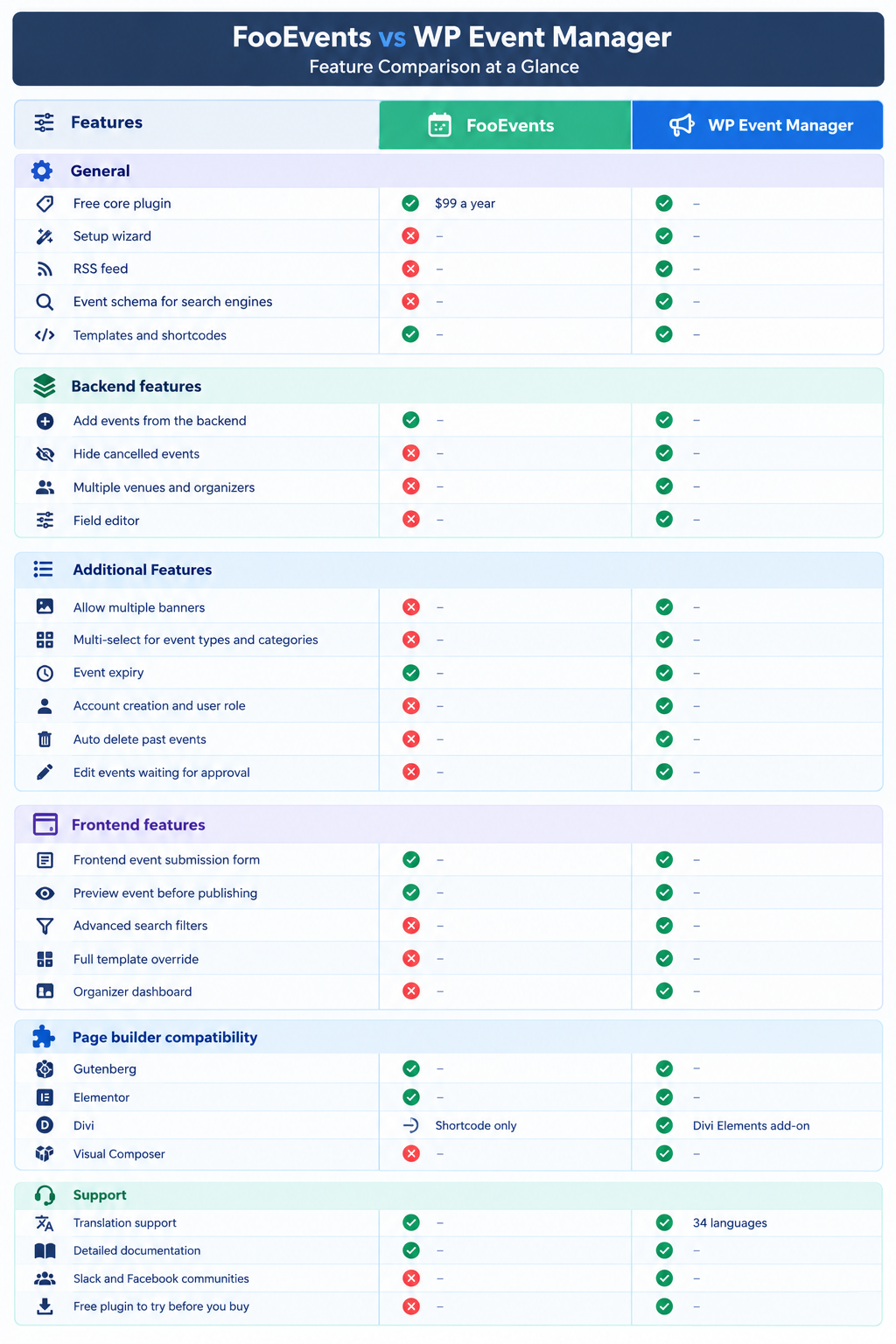
- Frontend event submission: Organizers can submit events from the front of your site without going through the admin, and you approve or reject them. WP Event Manager has this in the free plugin. FooEvents doesn't offer it.
- Customization options: Copy WP Event Manager's templates into your theme and change them however you like. The field editor lets you add or remove form fields too.
- Developer friendliness: There are shortcodes, Elementor widgets and a REST API add-on to work with, so developers don't have to build things from zero.
- Event preview: before an event is published, organizers can see how it looks and change anything that's off. FooEvents doesn't have a preview step.
- Multiple venues and organizers: WP Event Manager gives venues and organizers their own pages, and one event can show several organizers. FooEvents doesn't list venues or organizers as a feature.
- Advanced search filters: AJAX-based filters let visitors search events by keyword, location, date, type and category. FooEvents has no search filters on its listings.
- Hide expired events: WP Event Manager can hide past events from your listings and search, or delete them automatically, so visitors don't get confused by old dates.
- Multilingual translation support: Both plugins can be translated. WP Event Manager comes with translations in 34 languages.
- Support: WP Event Manager's team answers through its help center and support tickets, and you can also ask for tips in its Slack and Facebook communities. FooEvents offers a help center and a support ticket form.
FooEvents vs WP Event Manager: Feature Comparison Table
FooEvents vs WP Event Manager: Host Powerful Virtual Events with WP Event Manager
COVID-19 led to a boom in virtual and hybrid events that have remained popular due to their sheer convenience for attendees. You need reliable tools to run them well. WP Event Manager virtual add-ons enable you to host webinars, virtual conferences and full virtual or hybrid exhibitions:
- Expo Networking: Build virtual lounge, expo booths, reception area, interactive sessions and more.
- Zoom: Host webinars, virtual meetings and conferences directly from your event pages.
- Speaker and Schedule: Show us your speakers and when they’ll be speaking.
Want to see these add-ons in action? Phillip Dane, founder of Vintage Land and a WP Event Manager customer, has reviewed WP Event Manager's premium plugins in detail.
FooEvents vs WP Event Manager: Event Themes
Theme selection influences how consumers view your brand. There are lots of WordPress users who are finding it difficult to locate a theme that suits their brand as well as the plugins.
FooEvents does not include WordPress event themes. It’s Ticket Themes only change the ticket appearance. WP Event Manager offers 28 event themes designed to work with its add-ons, for all kinds of events, from conferences to concerts. You can preview each before you purchase.
FooEvents vs WP Event Manager: Pricing
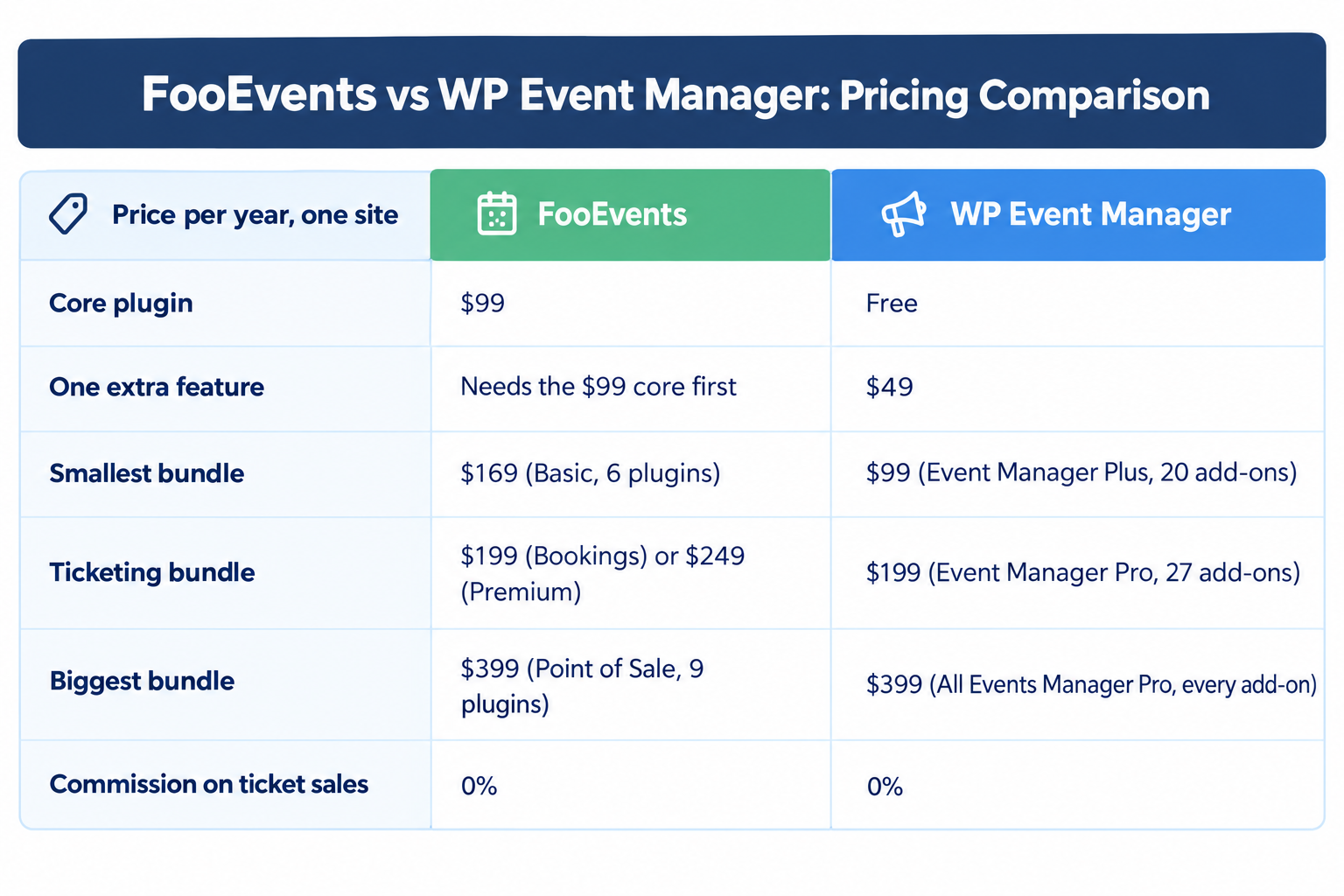
You can't use FooEvents without paying first. Its core plugin, FooEvents for WooCommerce, is $99 a year for one domain, and each paid extension like Bookings costs extra. Most people end up buying a bundle, which costs between $169 and $399 a year.
WP Event Manager's core plugin is free. You only pay when you need an add-on, and single add-ons start at $49 a year for one site. If you want everything, the All Events Manager Pro bundle has every add-on for $399 a year, the same price as FooEvents' biggest bundle, which has nine plugins.
If your WP Event Manager license runs out, your plugins still work. You just stop getting updates and support until you renew. Check the latest prices on the pricing page.
Wrapping Up
After comparing the two, it's clear that WP Event Manager is a complete solution for every type of event, including virtual and hybrid ones. FooEvents is good at selling tickets, but WP Event Manager gives you the listings, calendar, submissions, ticketing, marketing and virtual tools in one plugin. You can start with the free plugin from WordPress.org, try the add-ons on the live demo, and add only what your events need.
FAQs
1. Which is cheaper, FooEvents or WP Event Manager?
WP Event Manager's core plugin is free on WordPress.org, and single add-ons start at $49 a year. FooEvents' main plugin costs $99 a year before you add any of its paid extensions.
2. Do FooEvents and WP Event Manager charge commission on ticket sales?
Neither plugin takes a cut, since both sell tickets through WooCommerce. WP Event Manager also lets you sell donation tickets and split each sale with organizers through Stripe Split Payment.
3. Do FooEvents and WP Event Manager both need WooCommerce?
FooEvents is built on WooCommerce, so you need it before you can create a single event. WP Event Manager lists events, shows calendars and takes submissions without it, and you only add WooCommerce once you start selling tickets.
4. Which plugin is better for virtual and hybrid events?
WP Event Manager is the better choice, with add-ons for Zoom, Speaker and Schedule and Expo Networking. FooEvents offers a Zoom integration but nothing for speaker schedules or online networking.
5. Which plugin is better if other organizers post events on my site?
WP Event Manager has a frontend form to submit events and a dashboard to manage them. You approve each event before it goes live. FooEvents has no frontend event submission, so every event has to be added from the admin area.
About the Author