Use coupon code:
  Something exciting is coming soon – stay tuned to find out! 🚀✨
- « Previous blog
-
Grow My Business
-
May 21, 2026
-
May 21, 2026
-
651
-
0
- Next blog »
If you are planning to launch your eCommerce website in 2026, you must have been familiar with the two names: WooCommerce and Shopify. These are two of the most popular eCommerce platforms in the world. However, they serve different audiences.
Establishing an eCommerce business involves multiple decisions, including operations, marketing, and logistics. Choosing the right platform is certainly one of the most crucial ones among them. The platform you select determines how quickly you can start and the amount of control you have on data.
Shopify provides a comprehensive eCommerce solution that handles hosting, security and payments whereas WooCommerce is an open source and flexible platform that gives you a lot of controls but it requires your intervention when it comes to set-up and maintenance.
If you are confused about choosing the most suitable one between them for your business, this article is for you. This WooCommerce Vs Shopify guide cuts through the noise with a clear breakdown of what each platform does well.
Understanding WooCommerce and Shopify
Before we get to pricing charts and feature checklists, it's worth understanding what makes WooCommerce vs Shopify such a distinct pairing. These aren't two versions of the same product.
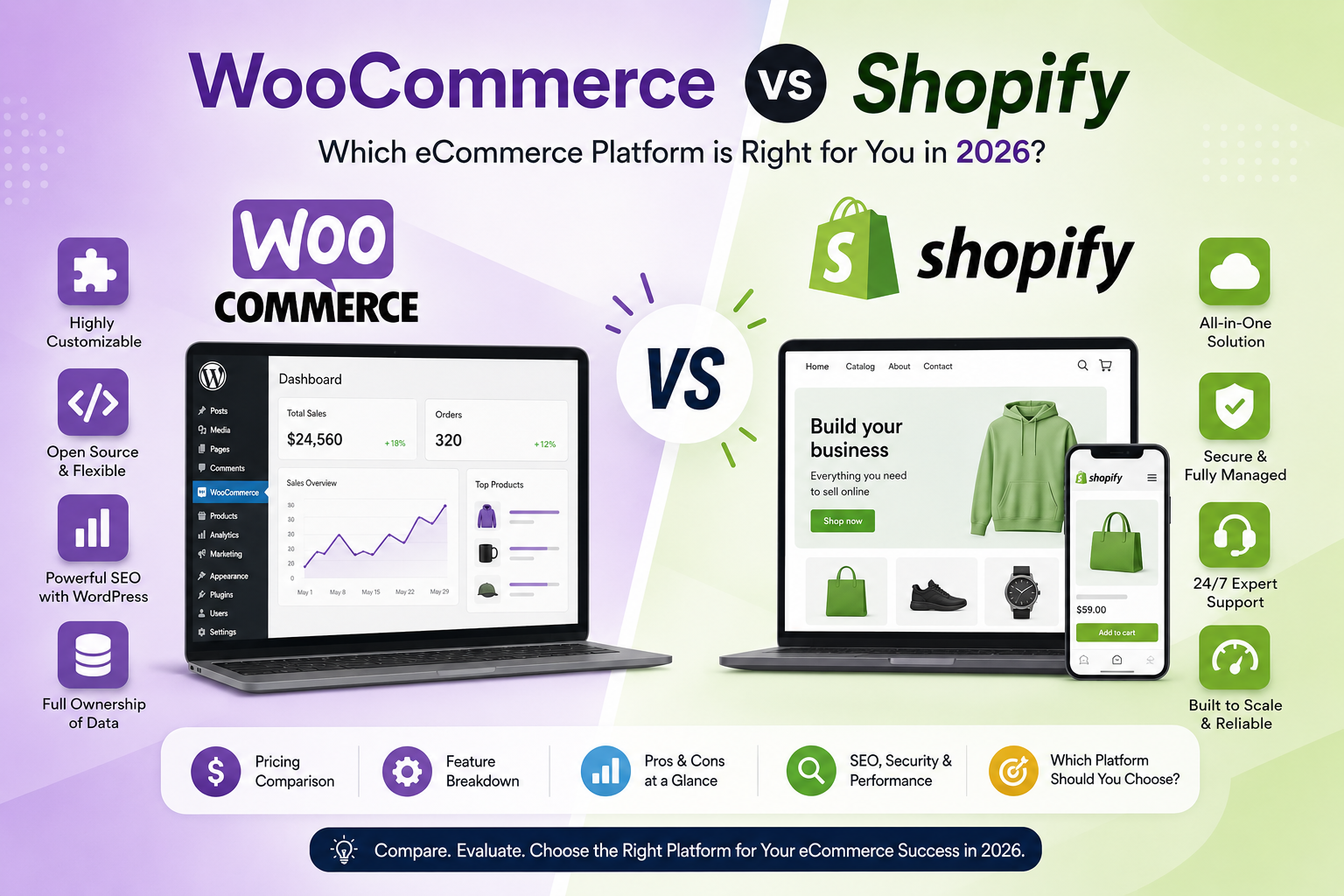
WooCommerce is a free and Open-Source WordPress Plugin. WooCommerce users manage the entire hosting environment, data and code.
2. ShopifyShopify is an all-in-one eCommerce platform that manages everything for you, including hosting, security, and updates. This means fewer choices and less headaches.
WooCommerce offers better flexibility to users with a lot of customizing options and it is free to install. On the other hand, Shopify is a fully hosted Software-as-a-Service (SaaS) platform.You need to pay a monthly subscription charge and it manages the whole infrastructure.
Let us explore their differences in detail.
WooCommerce Vs Shopify: A Detailed Comparison
1. WooCommerce Vs Shopify: Pricing
Pricing is where the biggest confusion occurs. Let us discuss this in detail in this WooCommerce vs Shopify study.
As mentioned above, WooCommerce is a free WordPress plugin but to launch a full fledged eCommerce website, you will need WordPress hosting plan, a domain name, SSL certificate, a theme and other essential paid plugins or extensions.
Moreover, WooCommerce Subscriptions cost $199/year, and WooCommerce Bookings $249/year. WooCommerce charges zero transaction fees. This means you only pay your payment gateway's standard processing fees via Stripe or PayPal.
Shopify renewed its pricing plans in late 2025. Current 2026 tiers are: Basic at $29/month, Grow (formerly "Shopify") at $79/month, Advanced at $299/month, and Plus starting at $2,300/month. These prices cover hosting, SSL, CDN, and PCI-DSS compliance. However, if you use a third-party payment gateway instead of Shopify Payments, Shopify charges an additional transaction fee on top of your gateway's own fees. Most business owners avoid this by using Shopify Payments, but unfortunately, Shopify Payments is not available in every country. This means the real Shopify cost sneaks up through its app ecosystem.
2. WooCommerce Vs Shopify: Ease of Use
The difference between WooCommerce and Shopify becomes prominent when it comes the ease of use. Shopify is developed for non-technical business owners as it handles the entire eCommerce infrastructure for users. As a user, you can set up your online store within hours without any code. Right from adding products to your store, configuring shipping, setting up payments, and customizing your storefront, all are handled through clean, intuitive dashboards.
In contrast, WooCommer has a comparatively steeper learning curve. It is mostly suitable for people who hold technical knowledge. Before installing WooCommerce, WordPress needs to be installed in your system. Besides this, you need a hosting environment that you've configured and an in-depth understanding of how themes, plugins, and the WordPress dashboard interact.
Though WooCommerce has become easier to use than before with managed WordPress hosts like Kinsta, WP Engine etc, when it comes to ease of use, Shopify wins the game.
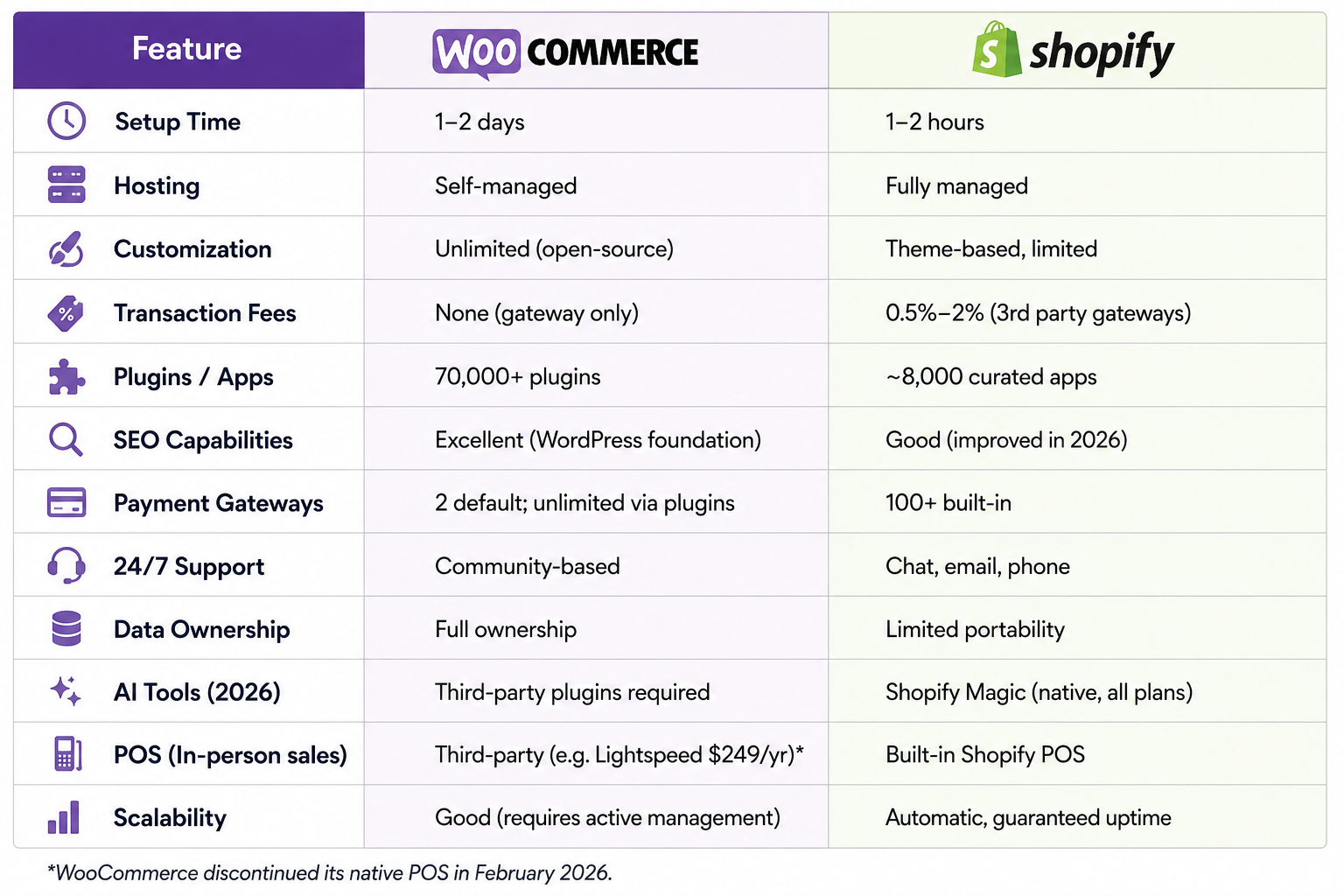
3. WooCommerce Vs Shopify: Features
4. WooCommerce Vs Shopify: SEO & Content Marketing
When the base of the comparison is SEO and content marketing, nothing can beat WooCommerce as it runs on WordPress, the gold standard for content management.
WooCommerce gives you access to mature SEO plugins like Yoast SEO and Rank Math, full URL structure control, superior blogging capabilities, and unlimited flexibility in how you structure your content hierarchy. If your business depends on your website traffic, WooCommerce is the best choice for you.
Shopify has improved its SEO capabilities considerably in 2026 by adding native schema markup and better meta tag control. One of the biggest limitations of the platform is that you cannot customize URL structures freely, and its blogging functionality remains basic compared to WordPress.
5. WooCommerce Vs Shopify: Security & Reliability
Security and reliability is one of the most important aspects of an eCommerce website. Analyzing the security factor in the WooCommerce Vs Shopify study, we found out that Shopify has a clear advantage here. As a fully managed platform, Shopify handles PCI-DSS Level 1 compliance (the highest payment security standard), automatic security patches, SSL certificates, DDoS protection, and 99.99% uptime guarantees.
This means business owners using shopping sleep peacefully at night without any worries of update and maintenance.
WooCommerce security remains entirely in your hand. You need to keep WordPress core, your theme, and every plugin updated.
You need to have a dedicated security plugin and a reliable host with built-in firewall protection, and have a backup strategy in place. This is certainly not impossible as millions of WooCommerce based stores are secure and well-maintained. However you need to keep your eyes open and pay careful attention to your site security.
WooCommerce Vs Shopify: Pros & Cons at a Glance
1. WooCommerce
Pros
- No platform transaction fees
- Complete ownership of data and code
- Multiple customizing options
- Search engine optimized
- Lower cost at high revenue volumes
- A perfect choice for content-driven stores
Cons
- Steep learning curve for beginners
- You need to manage hosting, security, updates
- Performance requires active optimization
2. Shopify
Pros
- Quick setup without technical knowledge
- Managed hosting, security, and SSL
- 24/7 customer support on all plans
- Shopify Magic AI tools (free, all plans)
- Guaranteed 99.99% uptime
- Excellent for scaling without ops work
Cons
- Transaction fees for third-party gateways
- Rigid URL structures limit SEO control
- Checkout customization locked to Plus plan
- Weaker blogging vs WordPress
Which Platform Should You Choose?
There is no universally correct answer in the WooCommerce vs Shopify debate. The right choice depends entirely on your business model, technical comfort, budget, and growth trajectory. Here's a practical framework:
WooCommerce is an ideal choice for you if you
- Already have a WordPress website
- Need full control and data ownership
- Your website is content-driven and SEO-focused
- Have technical skills or a developer
- Need deep customization or unique workflows
- Want to avoid platform transaction fees
Shopify is an ideal choice for you if you
- Are a beginner and want to launch your site quickly
- Want managed hosting and hands-off security
- Sell in person and need integrated POS
- Prioritize uptime and reliability guarantees
- Are using Shopify Payments (no extra fees)
Note: At WP Event Manager, we use WooCommerce to manage our payments and offer a 100% secured payment process to our customers. Our sites are well maintained to ensure that our customers' data remains safe.
About the Author