Use coupon code:
  Something exciting is coming soon – stay tuned to find out! 🚀✨
- « Previous blog
-
Grow My Business
-
May 14, 2026
-
May 25, 2026
-
1517
-
0
- Next blog »
It takes a lot of effort to build a well-designed website, but the biggest challenge lies in getting people to visit it. In this highly competitive digital landscape with ever evolving user behavior, website owners often struggle to drive traffic. Surprisingly, the reason is not poor content, but lack of strategies to attract and retain visitors. Using the right strategies, you can drive traffic to your website.
In this article, we have shared some effective tips and strategies to drive traffic to your website. Whether you're a blogger or a small business owner, this guide covers every proven strategy to drive targeted, sustainable traffic to your WordPress website in 2026.
Effective tips to drive traffic to your WordPress site in 2026
Discover some useful strategies that you can implement to drive traffic to your WordPress site in 2026.
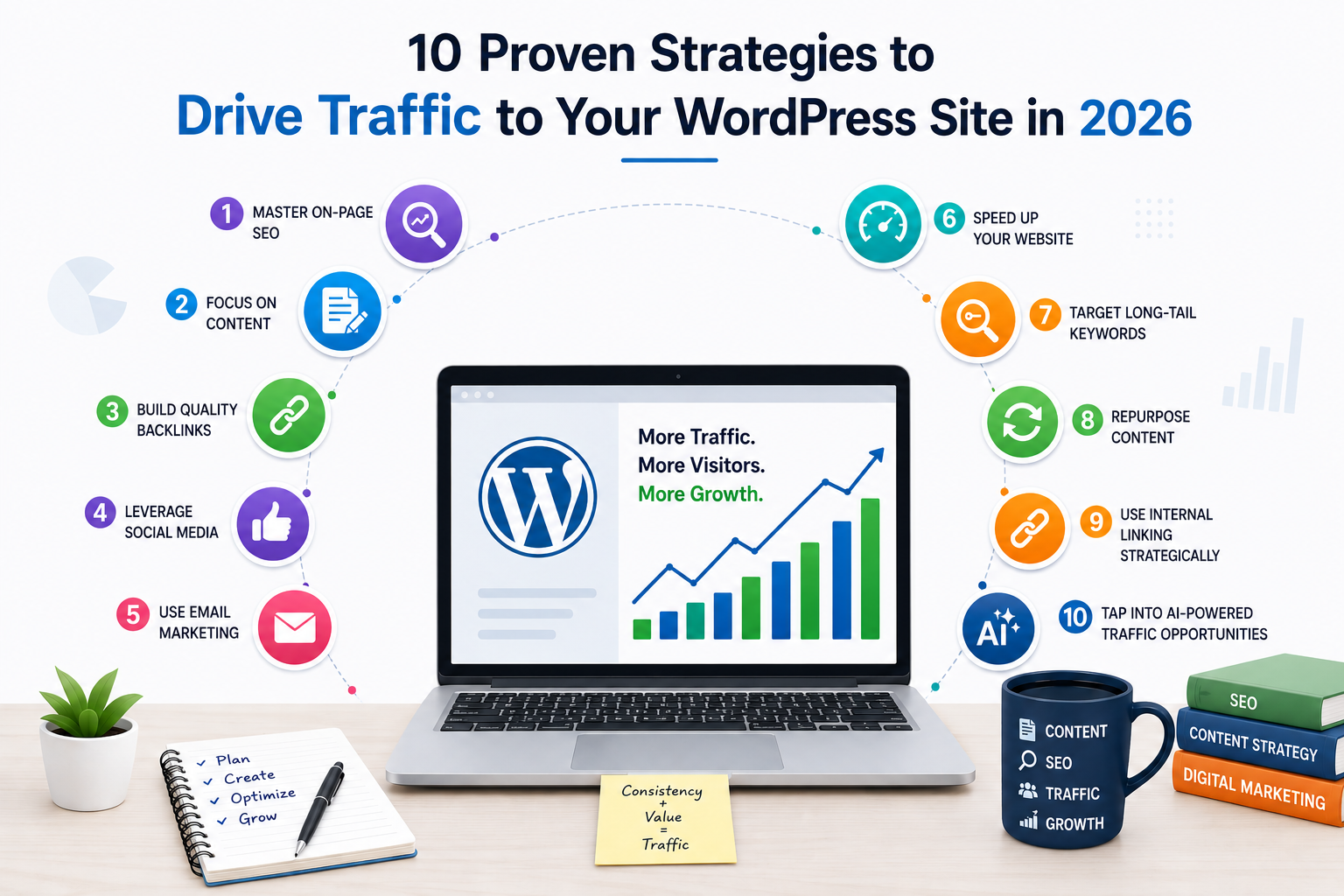
1. Master on-page SEO for WordPress
When it comes to website traffic, nothing can beat the effectiveness of SEO. Google's algorithm evolves with time, and in 2026, it has become more sophisticated, though the fundamentals remain the same. If your website is not optimized properly, you are not visible online.
Choose a reliable SEO plugin to begin the journey. Some of the most popular WordPress SEO plugins include Yoast SEO and Rank Math. They allow you to handle meta descriptions, titles, schema markup, etc without any code.
Consider the following tips to ace the art of SEO:
- Make sure to use your focus keyword in the page title, H2 and the first 100 words.
- Create interesting meta descriptions adding proper keywords within 160 characters.
- Use schema markup in your FAQs, How to guides, and articles to earn snippets.
- Strengthen images with proper ALT text.
2. Focus on the content
Your website content plays a pivotal role in bringing people to your website. In 2026, Google's Helpful Content System actively filters out thin, AI-spun content. To get visibility through content, you need to create content that genuinely answers user queries with authentic information.
The formula that works: write comprehensive, first-person, experience-driven content. Google's E-E-A-T (Experience, Expertise, Authoritativeness, Trustworthiness) framework rewards this.
Here are some tips to improve your content:
- Create in-depth articles on topics related to your niche.
- Make sure that the information you put is authentic including data, insights, case studies etc.
- Update your old content on regular intervals to ensure that they offer only the latest information.
- Add a FAQ section to your content to cover common queries on specific topics.
Pro Tip: Use Google Search Console to identify your web pages that are ranking between 8 to 15 positions. These are your "almost there" pages. With a little effort, like keyword fixing, information updating, etc, you will be able to improve their ranks.
3. Build an effective backlink strategy
Backlinks are the links from other websites pointing to pages on your website. This remains one of the most important factors for Google ranking. A quality backlink from a renowned website can do the things that dozens of on-page tweaks can not.
Here are some tips to help you gain backlinks:
- Create high quality articles or blogs to publish on a trusted and popular website in your niche in exchange for a link back to yours.
- Find broken links of your website on relevant sites and offer content as a replacement.
- Answer to journalist queries in HARO (Help A Reporter Out). If your answer is used by a journalist, you will earn backlinks.
4. Utilize social media
Social media acts as a traffic generating machine. The key in 2026 is picking one or two platforms and going deep rather than spreading yourself thin across six.
Here are the popular platforms that you can utilize:
- Pinterest: It is one of the highest referral traffic sources for WordPress bloggers especially in food, DIY, travel, and lifestyle niches. A single well-designed pin can drive traffic for years.
- LinkedIn: The best platform for B2B WordPress sites and professional bloggers. Long-form posts with links in comments outperform posts with links in the caption.
- Short videos (YouTube Shorts, Instagram Reels, TikTok): Use short videos to tease your content, then direct viewers to your WordPress site for the full guide
5. Use Email Marketing to Drive Repeat Traffic
Your email list is the only audience you truly own. Social media algorithms change. Google rankings fluctuate, but your email subscribers remain yours. Email traffic is also among the highest-converting traffic you'll ever get. These are people who already trust you.
- Add an opt-in form to your WordPress site using plugins like Mailchimp for WordPress.
- Offer a lead magnet (free checklist, template, mini-course) to incentivize sign-ups.
- Send a weekly or bi-weekly newsletter linking back to your latest posts
- Segment your list and send targeted content based on reader interests
Note: If you are running an events website, you can use the marketing add-ons of WP Event Manager that include Mailchimp, Hub spot etc. They automate email marketing and syncs attendee data across channels.
6. Speed up your website
Google's Core Web Vitals are a confirmed ranking factor. A slow WordPress site doesn't just frustrate visitors — it actively hurts your search rankings. Studies show that a one-second delay in page load time reduces conversions by 7% and increases bounce rate significantly.
Your 2026 speed checklist:
- Use a fast hosting provider (WP Engine, Kinsta, or Cloudways are top picks)
- Install a caching plugin — WP Rocket is the industry leader
- Serve images in next-gen formats (WebP) using Imagify or EWWW Image Optimizer
- Use a CDN (Content Delivery Network) like Cloudflare to serve your site faster globally
- Eliminate render-blocking JavaScript with WP Rocket or NitroPack
For a detailed checklist for speeding up your WordPress, read our previous blog on the same.
7. Target long-tail keywords
New WordPress sites cannot compete for broad terms like "weight loss tips" or "digital marketing." But you absolutely can rank for long-tail keywords — specific, lower-competition phrases that indicate high intent.
A new fitness blog would struggle to rank for "weight loss tips" (1M+ monthly searches, dominated by WebMD and Healthline). But "weight loss tips for women over 50 with thyroid issues" has lower competition and a highly specific audience who is far more likely to convert.
- Use free tools like Google Keyword Planner, Ubersuggest, or AnswerThePublic
- Target keywords with search volume between 100–2,000/month when starting out
- Create one dedicated post per keyword and don't cannibalize your own content
8. Repurpose content across every channel
You don't need more content — you need more mileage from the content you already have. Repurposing is how solo bloggers and small teams punch above their weight class.
- Turn a blog post into a YouTube video script
- Extract key statistics and turn them into an infographic for Pinterest
- Break a long post into 5–7 LinkedIn carousel slides
- Record a podcast episode discussing the topic in depth
- Create a Twitter/X thread summarizing the post's key points
One piece of content can realistically generate traffic from six different channels. That's six times the reach for the same effort.
9. Use internal linking strategically
Internal links pass SEO authority (called "link juice") across your site and keep visitors reading longer. Yet most WordPress bloggers treat internal linking as an afterthought.
- Link new posts to older, high-authority posts on your site
- Link older posts to your newer content to help it get indexed faster
- Use descriptive anchor text (not "click here" — use the target keyword)
- Aim for at least 3–5 internal links per post
10. Tap into AI-powered traffic opportunities
2026 is the year of AI search optimization. Tools like Google's AI Overviews, ChatGPT Search, and Perplexity AI are becoming primary discovery channels. Getting cited by these AI tools can send high-quality, intent-driven traffic to your WordPress site.
- Write clear, concise definitions and explanations — AI tools love extractable answers
- Use structured data (schema markup) to help AI systems understand your content
- Build brand authority — AI tools cite sources they've seen cited elsewhere
- Maintain an updated "About us" page and author bios that establish your credentials
- Several WordPress site owners have reported significant referral traffic from Perplexity AI citations in 2025–2026. Being the definitive, well-structured answer to a niche question is the fastest path to being cited by AI search tools.
Final Thoughts
Driving traffic to your WordPress site in 2026 is not about one magic trick — it's about building a system where SEO, content quality, speed, social distribution, and email marketing all work together. The sites that win aren't the ones with the biggest budgets; they're the ones that are consistent, strategic, and genuinely helpful to their audience.
Start with two or three strategies from this list, execute them well for 90 days, and measure your results in Google Analytics and Search Console. Then stack on the next strategy. Traffic compounds — just like interest in a savings account. The bloggers who win are the ones who start today and keep going.
About the Author