Use coupon code:
  Something exciting is coming soon – stay tuned to find out! 🚀✨
- « Previous blog
-
Events
-
Dec 3, 2025
-
Dec 3, 2025
-
6160
-
0
- Next blog »
Event marketing is one of the most crucial aspects of event planning that also requires proper planning and execution. When it comes to event marketing, reviewing the marketing funnel is the first step that you take. Your marketing funnel is nothing but the path through which your attendees create the journey from discovering your upcoming events to purchasing tickets for them.
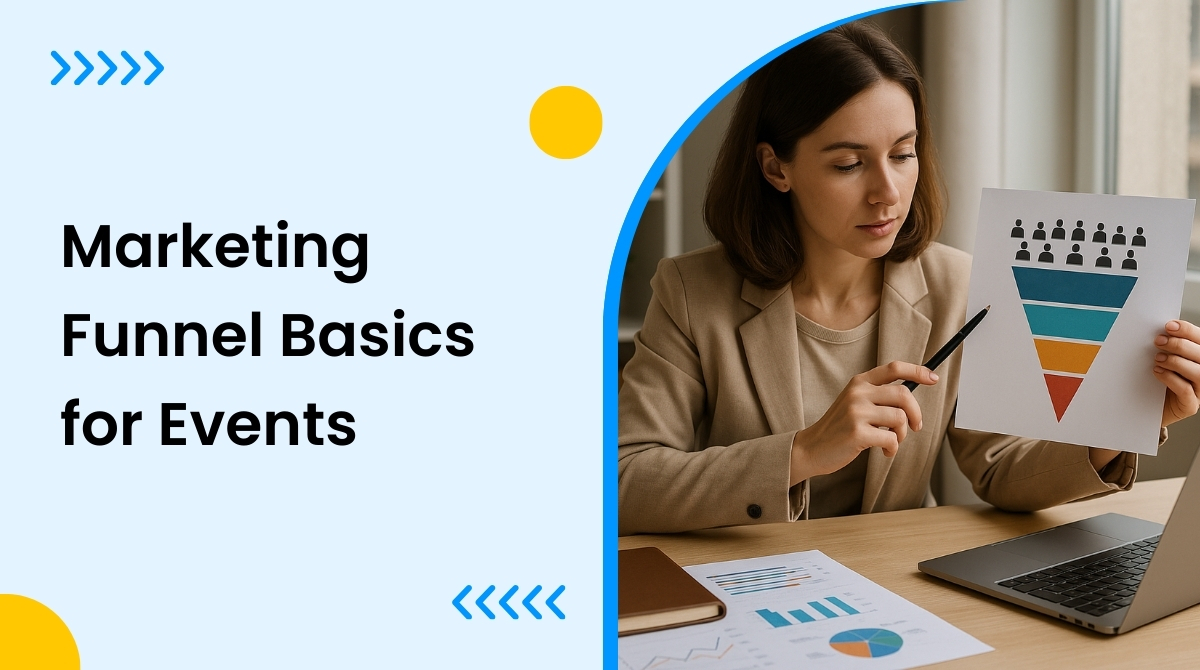
In simple words, a marketing funnel for events gives you a clear understanding of the stages your attendees pass through before buying event tickets. So optimizing these stages ultimately increases your ticket sales and enhances your overall attendee experience and event performance. To make it happen, you need to know about the marketing funnel basics for events.
In this article, you will learn about an event marketing funnel, marketing funnel basics, and how you can utilize them in your next events. Let us begin with a brief introduction to the event marketing funnel.
What is an event marketing funnel?
An event marketing funnel is the road that shows the journey that people experience from discovering about your event to becoming attendees. Knowing the stages of your event marketing funnel allows you to plan and determine actions at every step right from event awareness to conversion. As an event organizer, with the help of event marketing funnel basics, you can identify your target audiences, monitor performance, and make the right decisions for your events.
Your event promotion remains incomplete and less effective when you avoid analysing your event marketing funnel.
Why marketing funnel for events matters?
As mentioned above, a marketing funnel for events determines how your target audiences find out about your upcoming event, analyse or evaluate it, and finally buys tickets to become an attendee. Event marketing without considering the event marketing funnel basics becomes an assumption-based marketing that carries a little scope for success.
Understanding event marketing funnel basics helps you:
- Reach out to the right audiences.
- Share the right message to the right audience to push them towards registrations and tickets.
- Craft suitable content for different stages of the funnel and offer personalized experience to audiences.
- Closely monitor each stage to find out the areas where drop offs occur and improve them.
- Engage audiences at every stage of the event.
Now that you are aware of why understanding event marketing funnel matters, let u discover the marketing funnel basic for events.
What are the marketing funnel basics for events?
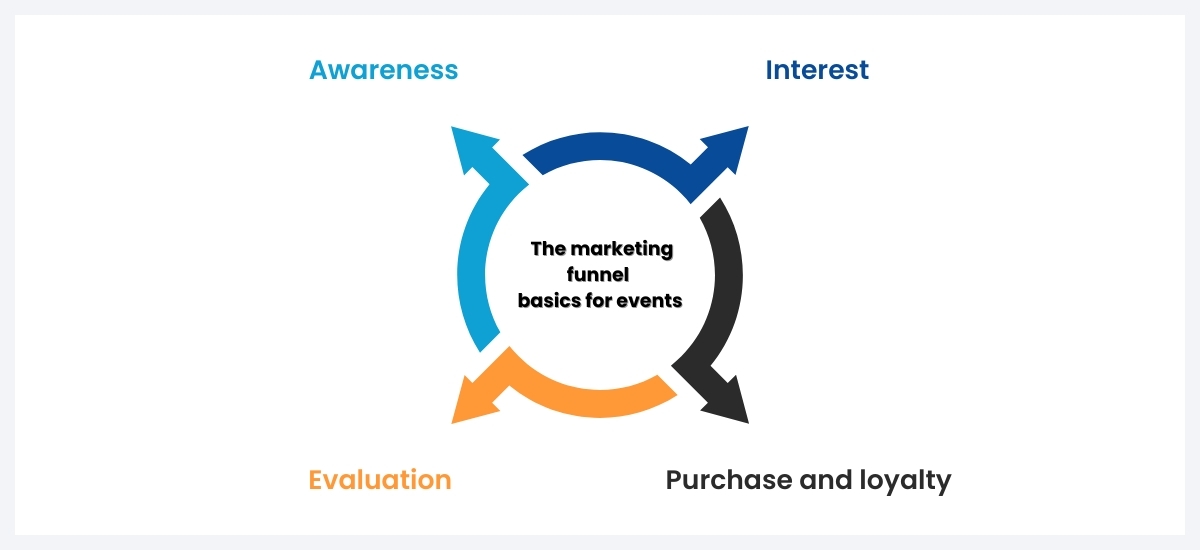
1. Awareness
The first step of event marketing funnel basics is spreading awareness about it among your target audiences. Make sure you create a good impression of your event on your audiences because this is how your audiences will hear about your event and brand for the first time.
Consider the following tips to reach out to the maximum number of audiences:
- Start by building an event listing on your WordPress events website.
- Use an event calendar to display the dates and details of multiple events you organize.
- Embrace email marketing and send an event announcement message through email.
- Post about your event announcement on all social media platforms.
- Go for influencer marketing.
- Send newsletters.
- Run contests and games to engage audiences.
if this sounds overwhelming, use the right tools to simplify and automate the above mentioned tasks. We recommend using WP Event Manager as it offers a comprehensive event management solution to all your event requirements.
Starting from adding an event listing to your website to calendar, registration and email marketing everything is possible with WP Event Manager and its premium addons.
Besides this, even if you know your target audiences, there is no harm in doing a little bit of research. Evaluate your past events, ask for feedback, scrutinize attendee data on social channels and website to understand what your attendees like.
2. Interest
The interest stage is the second in your event marketing funnel, in which audiences learn about your upcoming event. As they have already found out about your event at the first stage, now they will be curious to know more about it. The main objective behind this stage is to provide detailed information about your event to attendees.
Consider the following tips to help your event audiences move ahead to the second stage of the event marketing funnel:
- Divide attendee emails into various categories for send targeted messages.
- Create relevant blogs to post on your website.
- Prepare social media post to share details of your events with followers.
- Add video content to promote your upcoming events.
- Share past attendee experiences on your social channels and website.
- Revamp your event landing page, highlight details, and provide HD images to attract people.
In a nutshell, when it is about offering event details to your audiences, make sure that your content is interesting enough to grab the attention of people. Ask your sponsors and partners to follow the same to involve more and more people with it. This will also help you get more registrations and social media followers for your events.
3. Evaluation
This step is all about the audience's judgement, which means at this stage, interested people will examine if attending your event will be beneficial for them. As an event organizer, your aim is to encourage them to purchase event tickets.
Consider the following tips to do that:
- Run social media ads.
- Prepare a strategy to recover abandoned cart.
- Create special offers and discounted ticket prices.
- Give early bird discounts.
- Show the number of tickets sold or the number of remaining tickets to create a sense of urgency.
Go through your past marketing funnel activities to find out the missing things. if you notice that people left without completing the funnel, look for the causes of it. For example, if it is because of a complicated registration process or lack of marketing strategy. Based on this, you can take steps to improve the process for your next event.
4. Purchase and loyalty
The last and most important step in your event marketing funnel is the process of becoming an attendee by purchasing event tickets. This is the stage at which people interested in your event finally become your attendees.
Consider the following tips to optimize the process:
- Make sure you have a simple event registration and ticketing process.
- You also need to offer a secured payment process.
- You can introduce a referral program to encourage these attendees to refer your events to their friends and family.
- Offer them rewards to promote your events by posting on social media platforms, writing testimonials on your website etc.
Even after completing the funnel, it is important for you to stay in touch with your attendees with event reminders, during the event activities, and post event feedback.
Event marketing with WP Event Manager
WP Event Manager is one of the most trusted event management plugins that offers a set of event marketing addons that are developed by integrating various CRMs like Zoho, Mailchimp, Hubspot and more to simplify event marketing for all event organizers. They not only help sync attendee details to various platforms but also automate email marketing with personalized email content.
Wrapping up
We hope that now you have a clear idea about the concept of event marketing funnel and are well aware of the marketing funnel basics. The marketing funnel for events helps you make major marketing decisions while creating a marketing strategy. When it comes to optimizing your event marketing efforts with tools, trust a plugin like WP Event Manger that will improve and automate marketing and increase registration, ticket sales and attendee satisfaction with its premium addons.
About the Author