Use coupon code:
  Something exciting is coming soon – stay tuned to find out! 🚀✨
- « Previous blog
-
Events
-
Feb 3, 2026
-
Feb 10, 2026
-
1994
-
0
- Next blog »
Your event's success goes beyond registrations, it hinges on the way you handle the payments. When it comes to payment gateways for events, the first few names that come to mind include Stripe and PayPal. Both are popular and involved in millions of transactions globally. However, their payout speed, fees, and user experience are different from each other, which may have a significant impact on your business and attendee experience.

That is why it is essential for event organizers to know each platform closely and their competitive features to determine which is the best option for them. To help you, we have shared a detailed competitive study between Stripe and PayPal for events in this article.
The Stripe Vs PayPal article covers everything including their fee structure, speed, global reach, flexibility, and more that you will need to find out which is better for events. Before diving into the main topic, let us first discuss why the payment gateway choice matters for event organizers.
Why payment gateway choice matters for events?
For every event organizer, the role of a payment gateway goes beyond just a technical tool as it directly influences:
- Event ticket sales.
- Attendee trust.
- Revenue retention.
Remember that the transaction fee imposed on every ticket reduces the final revenue per ticket, which turns into a huge amount for events that deal with a huge number of passes. This means it eats up a large portion of your profits. Clearly, the payment gateway you choose between Stripe and PayPal determines the money that goes into your pocket after each sale.
Even a small amount of difference in fee can become huge for big events with bulk attendees.
Stripe Vs PayPal: Detailed Comparison
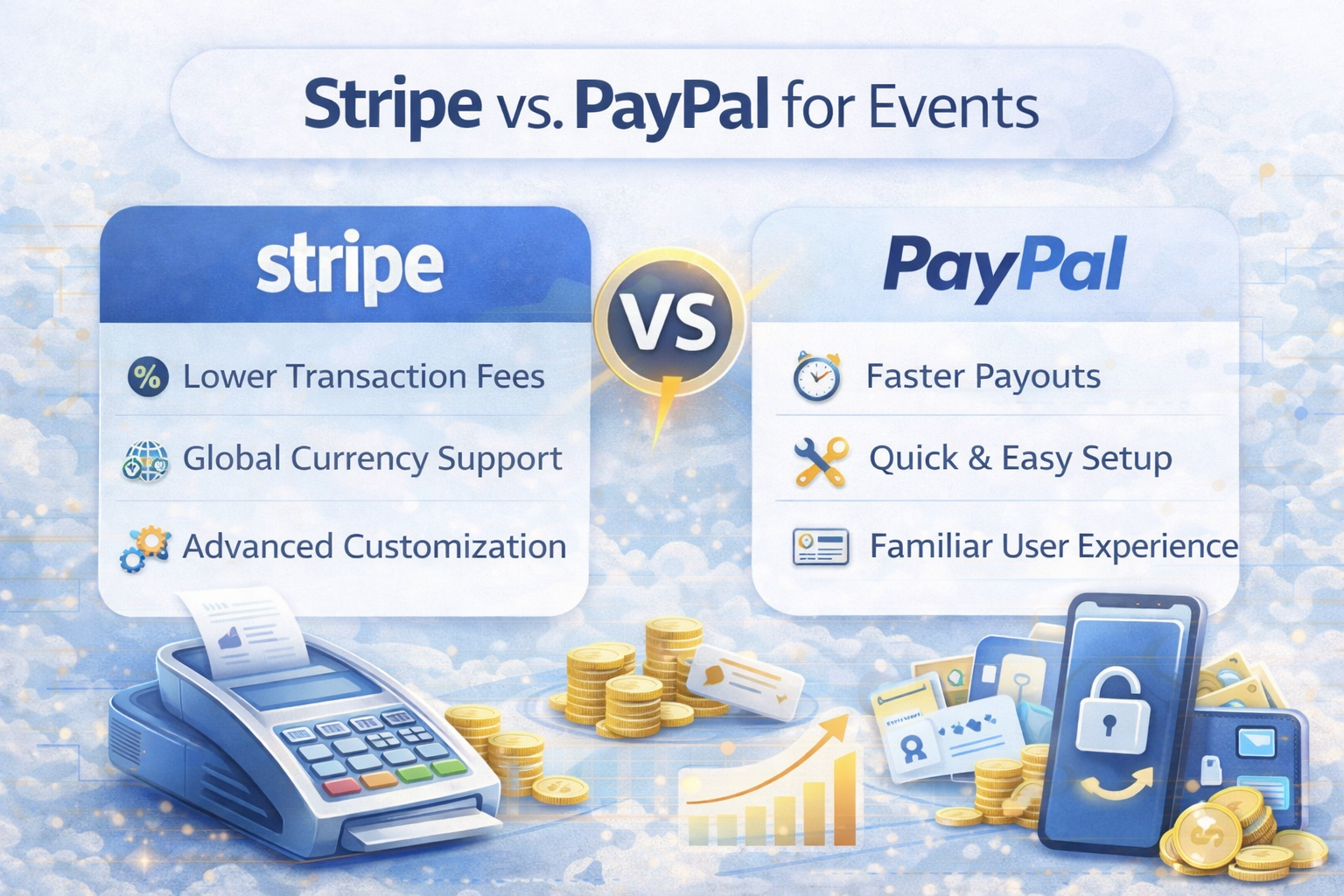
Now let us discover the competitive features in this Stripe Vs PayPal study:
1. Stripe Vs PayPal: Fee structure
Both Stripe and PayPal deal in transaction based pricing structure with certain differences. Here are the details of Stripe Vs PayPal in terms of fee:
- Stripe asks for 2.9% + $0.30 per transaction for standard online payments. On the other hand, PayPal charges around 3.49% + $0.49 per transaction.
- Stripe offers lower cross border fee with smaller currency conversion costs that ranges between 1% to 2% to event organizers whereas PayPay typically charges around 3% to 4% for the same.
- Considering the chargeback fee per dispute, Stripe demands $15 while PayPal costs $20.
- The fee structure of Stripe and PayPal differ for ticket prices below $10. PayPal charges 5% + fixed fee whereas Strip sticks closer to its standard fee.
Verdict: When it comes to cost per event ticket sale, Stripe is a more affordable option than PayPal, which makes Stripe an appropriate choice for events with a huge number of ticket sales.
Similarly, if your event involves global attendees and international transactions, Stripe is a smarter pick due to its smaller currency conversion cost which keeps the overall cost lower than PayPal.
2. Stripe Vs PayPal: Payout timeline
Payout timeline refers to the time it takes the ticket revenue you collect to reach your bank account. When it is about maintaining a consistent cash flow, the payout timeline makes a significant difference. Stripe's standard payout ranges between 2 to 3 business days. However, an instant payout option is also available with an additional fee. PayPal takes 1 to 3 business days as payout time for standard bank transfers, and additional charges are applied for instant payout, which takes around 30 minutes.
It is essential for every event organizer to get quicker access to funds, especially when your ticket revenue is used to clear vendor payments or marketing expenses.
Verdict: PayPal allows almost instant balance availability for event organizers, making it a great choice for small events, whereas Stripe takes a bit longer as payout. So if you want to use Stripe as your event payment gateway, you need to have a solid cash-flow plan. It is mainly suitable for huge events or recurring events with a planned payout schedule.
3. Global reach and flexibility
For events that attract global audiences, cross-border fees and currency conversion costs are crucial as they ultimately determine how accessible your event is to a global audience.
- When it comes to currency support, Stripe wins the race with 135+ currencies, whereas PayPal is limited to 25+ currencies..
- Stripe is a good option for those looking for custom checkout with developer-centric approach whereas PayPal is for users who are already aware of the checkout process.
Verdict: After scrutinizing the global currency support and flexibility in Stripe Vs PayPal comparison for events, Stripe turns out to be an ideal choice for events with global audiences due to its lower international transaction cost, whereas PayPal is suitable for those who are familiar with the checkout system.
4. Stripe Vs PayPal: User experience
The user experience is another important factor that needs to be taken into consideration in the Stripe Vs PayPal study. PayPal usually does not require much technical configuration, which makes the setup process easy and convenient for event organizers. In contrast, Stripe offers a customized checkout experience along with advanced subscription tools that allow developers to have better control on the entire payment process.
Verdict: PayPal can be an ideal choice for small event teams or event organizers who lack technical expertise as the process of setting it up is easier than Stripe. On the other hand, Stripe can be a suitable choice for those looking for branded ticket flows and advanced customization.
Keep in mind that a smooth and secure check-out process significantly reduces ticket abandonment and increases the conversion rate.
5. Stripe Vs PayPal: Mobile and customization
In this advanced digital era, mobile experience and customization are extremely important, especially when payments and transactions are involved. PayPal lets you use your smartphone as a detailed checkout counter. You can accept cash, cards, against your event tickets and easily handle your loyalty programs with automatic inventory updates.
At the same time, Stripe's mobile app comes with a few limitations. For example, it does not allow cash transactions. However, Stripe's functionalities go beyond the App. One of the biggest advantages of using Stripe is their API that helps you create everything you want. You can create a full-fledged branded checkout page and offer a seamless checkout experience to your attendees.
Stripe Vs PayPal: Which is better for Events
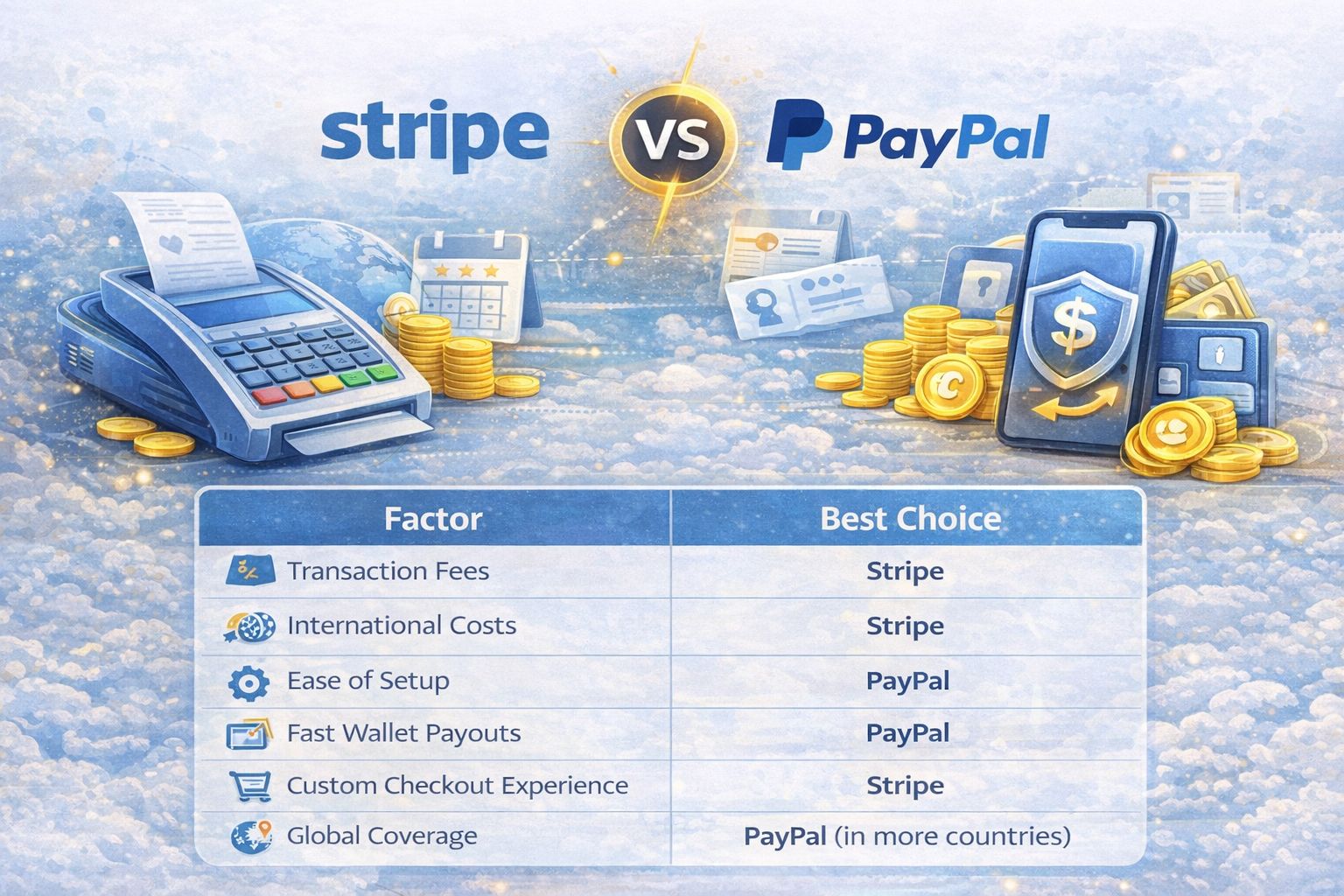
Both the payment gateways have their own pros and cons. Which is better for your events completely depends on your requirements. Let us understand the Stripe Vs PayPal study through a chart to help you quickly understand which is better for your events.
Stripe and PayPal both are suitable for selling event tickets online. However, considering the affordability factor and international transactions, Stripe is a better payment option than PayPal. Again, for small events that require simple payment workflows, PayPal works better than Stripe
Note: If you use WP Event Manager for our WordPress events, you can use the Stripe split payment add on that automatically divides the ticket revenue between website owner and event organizer.
Wrapping up
We hope that the detailed Stripe Vs PayPal competitive study will help you understand their unique features along with pros and cons so that you don't need to struggle to choose between one of them.
- Stripe offers clearer, often lower fees per transaction and outstanding global support.
- PayPal shines when it is about the ease of use and near-instant payouts to its own balance.
For event organizers who manage bulk tickets and global attendees, Stripe is an appropriate choice. However, when it comes to a hassle free payment system, PayPal is preferred.
About the Author