Use coupon code:
  Something exciting is coming soon – stay tuned to find out! 🚀✨
- « Previous blog
-
Grow My Business
-
Jan 15, 2026
-
Jan 16, 2026
-
10327
-
0
- Next blog »
There is a common saying in the world of SEO: if you want to hide something, put it on the second page of Google. Research shows that nearly 75% of users never scroll past the first page of search results, highlighting how critical first page visibility is for Google search success. This makes search engine optimization an absolute necessity for all businesses.
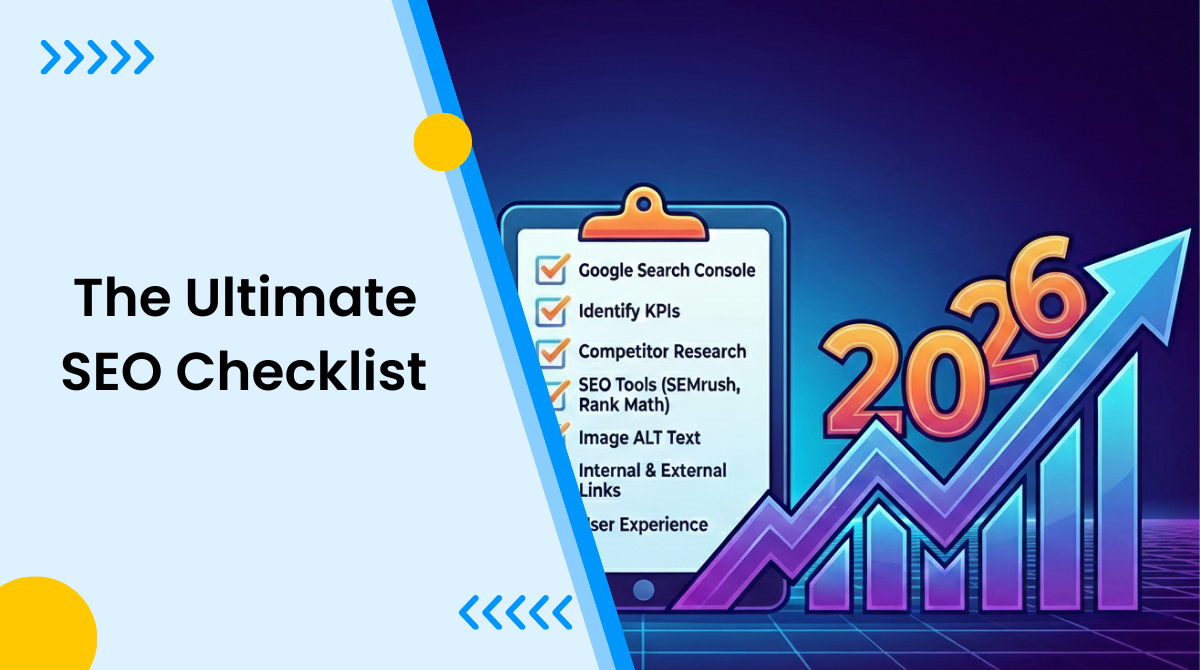
SEO is no longer confined to keywords and good content. It is a multi-step process that involves keyword research, technical modification, link building, and more. This might be a bit overwhelming for beginners, especially when it comes to keeping pace with the constantly changing algorithm. That is why we have come up with this SEO checklist that is beginner-friendly and help you understand what exactly you need to do to improve your site performance.
SEO Checklist for 2026
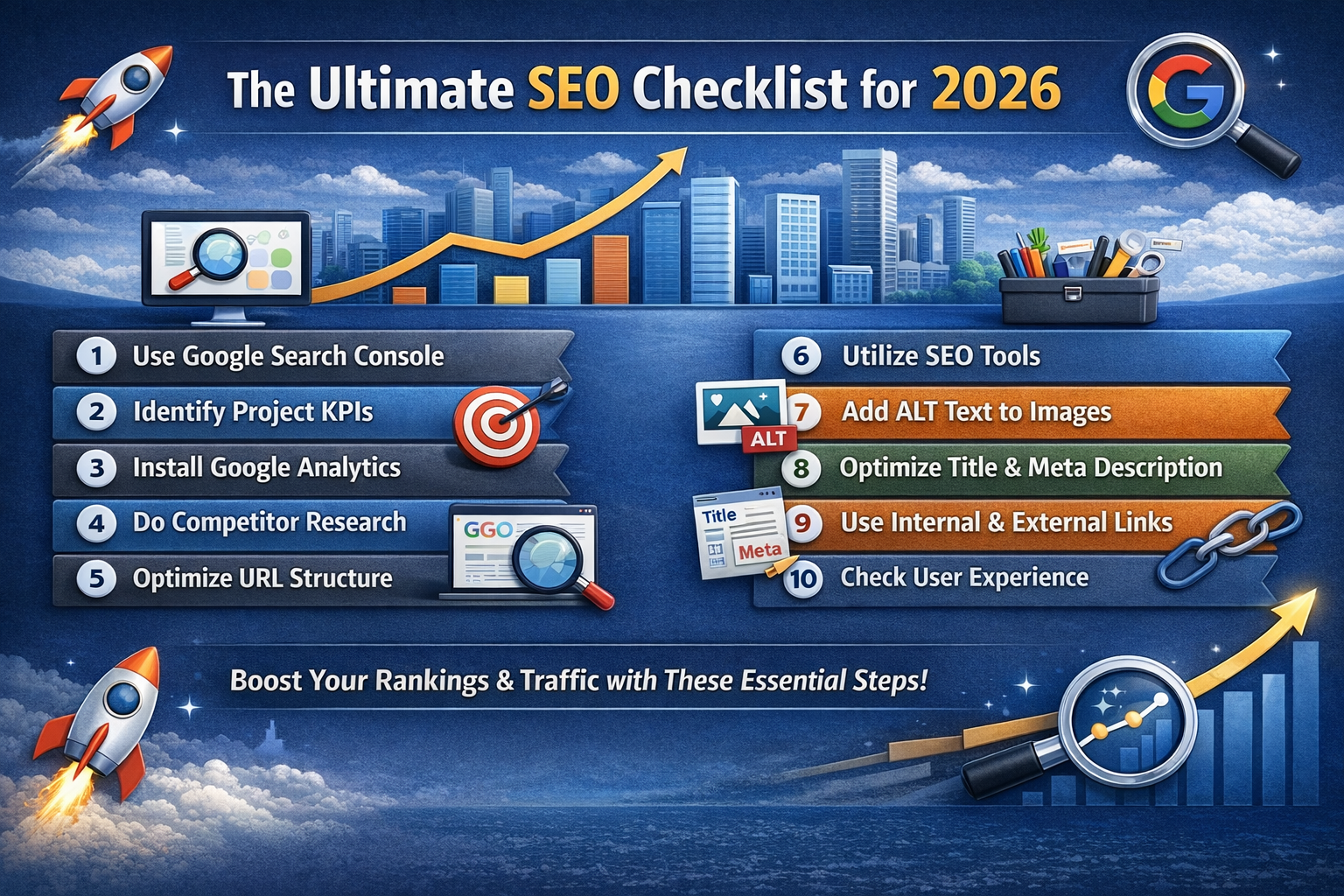
1. Use Google search console
Google search console is a free tool that lets you monitor your website's performance on Google search results. With Google search console, you will be able to keep an eye on your search traffic, solve issues, and find out the way Google indexes your web pages.
The Google search console features allow you to track the following things:
- The keywords that drive maximum traffic on your website.
- Identify and fix website errors.
- The performance score of your core web vitals.
- Display sitemap.
The journey to improve your website SEO starts with Google search console.
2. Identify project KPIs
Besides the right SEO tools, you must be aware of your ultimate goal. In simple words, you should know what is the main objective behind your SEO efforts. Tracking the key performance indicators (KPI) for your website performance helps you determine whether you are on the right track.
Discover some key performance indicators:
- Brand awareness: Being prominently visible online automatically drives your target audiences engagement with your brand. This increases your brand credibility as well.
- Increased backlinks: High quality backlinks significantly improve your site authority which is essential to again a good position in Google search results. Achieving a higher rank on Google search result means higher traffic.
- Keyword ranking: Knowing where your targeted keywords are ranking help you make changes accordingly.
- Organic traffic: Gaining more traffic on your website through Google search results increases your sales without any paid efforts.
In addition to the above mentioned KPIs, if you want to dive deeper, you can track elements like your page loading time, bounce rate and sales performance.
3. Install Google analytics
After Google search console, the next SEO tool that we recommend you is Google analytics that shows how people discovers your website online.
Google analytics enlightens you on the following areas:
- Identify your website pages that brings most traffic.
- Check if your traffic is constantly going up or down.
- How many visitors you get through Google.
- Find out sites and search engines that are giving you traffic.
- Monitor your website's engagement level, time spent there, and page views.
Using Google analytics and Search console together gives you useful SEO information in your Analytics account.
4. Initiate competitors' research
Being aware of your competitors' actions is also crucial for your site SEO especially those who rank higher on Google search results. This is one of the crucial points in our SEO checklist that helps you find out the areas of opportunity and limitations in your SEO strategy.
Consider the following tips while doing competitors' research:
- Find your competitors' niche by using target keywords and scrutinizing the top-ranking pages.
- Install SEO tools like SEMrush, Rank Math etc to examine the backlinks of your competitors, best performing articles, keyword strategies etc.
- Track their content structure, keywords and strategies to utilize the successful ones.
5. Check your site's URL structure
The next in our SEO checklist is optimizing your site's URL structure. Search engines use website URLs to understand the content of a website or webpage. Usually clean and easy URLs are preferred as they help search engines and website visitors get a clear idea about the page content.
Google instructs website owners to create URLs that are relevant to the page content. This increases click-through rates and makes it easy to understand.
Consider the following tips to make your URLs SEO friendly:
- Add the focus keyword to it.
- Be precise and clean.
- Make it short.
- Use the correct categories or subfolders.
6. Consider using SEO tools
There are various SEO tools available for users to speed up the SEO game. Using these tools is also important as a part of following the SEO checklist. They help you get authentic and in-detail insight on your website performance to let you access your search engine ranking, identify problems and modify and improve content accordingly. Most importantly, they help automate various SEO tasks which saves your time and effort.
Some of the popular SEO tools include:
- SEMrush: A well-known SEO software for thorough keyword research, competitor's analysis and website audit.
- Rank Math: A powerful tool that lets you optimize your website content for search engines, identify keyword, schema markup, and track performance .
- Yoast SEO: It is a WordPress SEO plugin that improves your website's search visibility through page optimization, readability, and structured data implementation.
Google analytics and Search console also fall under this category as they provide useful insights on your website performance, indexing and traffic.
7. Add ALT text to images
When it comes to SEO checklist for 2026, image optimization can not be missed. It is as important as optimizing your website content because images make your content more understandable.
However, Google can not understand images. To make them understandable to Google, you need to add ALT tags and filenames. You might be surprised to now optimized images also plays a major role in improving your rank on image search resuts.
Make sure you use ALT tags that are easy to understand and contain keywords.
8. Optimize meta description
Meta description is the short but descriptive text that appears under your page title. It helps users understand what the page is about. Though it is not a direct website ranking factor but a well-structured meta description certainly increases your chances of acquiring a higher rank on Google which is why we have included this in our SEO checklist for 2026.
Keep in mind that meta descriptions must be written within 160 characters.
9. Use internal and external links
While posting a new content, try to add links of 2 or more relevant pages on your site to it. This not only increases traffic to the other pages of your site but also guides readers to relevant topics and makes them stay longer on your site.
Similarly, adding external links to your content is equally important as it allows readers to verify the Information you provide and explain terms in detail that you have not in your content. It also indicates search engines that your content is well researched and information is taken from reliable sources.
10. Check user experience
The final point in our SEO checklist is improving user experience. It is all about encouraging people to stay longer on your website. It is an SEO factor that is directly related to your sites click through rate. This is because if people don't click on your website, they won't access the content or buy products from it. The chances of conversion automatically increase when they stay longer on your site.
Consider the following tips:
- Use easily understandable URL and meta description.
- Add impressive titles.
- Make sure to create schema markup for better reach.
- Build high-quality informative content.
- Increase page speed.
Wrapping up
We hope that our SEO checklist guide will help you improve your website's Google search ranking. Make sure you follow all of them including competitors' research, tracking KPIs, adding internal and external links, improving user experience, using the right tools and more without filtering to get the best results.
About the Author