Use coupon code:
  Something exciting is coming soon – stay tuned to find out! 🚀✨
- « Previous blog
-
Events
-
Apr 20, 2026
-
May 25, 2026
-
3109
-
0
- Next blog »
If you're running an event website powered by WP Event Manager, you already have a powerful platform to showcase your events. However, publishing events online is only half the battle — the other half is ensuring that the right people can actually find them. That’s where SEO for event website success comes in, helping your pages rank higher on search engines and attract more attendees.
This guide walks you through every major pillar of event SEO: from keyword research and on-page optimization to technical best practices, local search, and post-event strategy. Whether you manage a single annual conference or a calendar full of recurring events, these strategies and the practical SEO checklist will help you drive more organic traffic, attract better-qualified attendees, and reduce your dependence on paid advertising.
Why SEO Matters More Than Ever for Event Websites
Most event organizers invest heavily in social media campaigns and paid ads while leaving organic search almost completely untapped. That's a costly oversight. When someone searches "fintech conference Mexico 2026" or "corporate team-building events near me," they are not browsing — they are actively looking for exactly what you offer. These are high-intent visitors who are far more likely to register than those who stumble upon a Facebook ad.
Organic search rankings don't charge per click. Once you earn a strong position on Google, that visibility works for you around the clock without ongoing ad spend. And unlike social media posts that disappear from feeds within hours, a well-optimized event page compounds in authority over time — especially for recurring events that build SEO equity year after year.
1. Keyword Research: Think Like Your Attendees
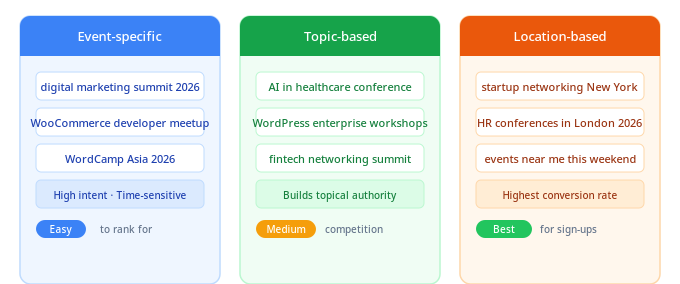
Event keyword research is fundamentally different from other industries because your audience searches with time, location, and topic specificity in mind. Broad terms like "marketing conference" are dominated by large publications and aggregators. The real opportunity lies in targeting three categories of keywords:
Event-specific keywords include the name, year, and format of your event, such as "digital marketing summit Canada 2026" or "WooCommerce developer meetup."
Topic-based keywords focus on the subject matter rather than the event itself — for example, "AI in healthcare conference" or "WordPress for enterprise workshops."
Location-based keywords combine the subject and geography, such as "startup networking events in Atlanta" or "HR conferences in New York." These consistently outperform generic terms in conversion because they filter for genuine local intent.
To find the right mix, use tools like Google Keyword Planner, Ahrefs, or SEMrush. Pay attention to question-based search patterns as well. With the rise of AI-powered search tools, users increasingly phrase queries as full questions: "What are the best e-commerce conferences in the USA for 2026?" Structuring parts of your content to directly answer these questions improves your chances of appearing in featured snippets and AI-generated search overviews.
Avoid keyword stuffing at all costs. Repeating your target phrase in every paragraph no longer improves rankings — it actively hurts them. Use keywords naturally and focus on writing content that genuinely serves your audience.
2. On-Page Optimization: Every Page Is a Ranking Opportunity
Your event listing pages are the foundation of your SEO strategy. Each page should be treated as a standalone landing page with its own optimization focus.
Title Tags and Meta Descriptions are the first things both search engines and users see. Your title tag should include the event name, location, and year — for example, "WordCamp Asia 2026 | WordPress Conference in Berlin." Meta descriptions should be concise, compelling, and include a clear call to action that encourages clicks from the search results page.
Header Structure (H1, H2, H3) signals content hierarchy to search engines. Your H1 should match the primary keyword for the page. Use H2s and H3s to break down sessions, speakers, schedules, and FAQs — each representing an additional opportunity to target a related keyword.
Image Alt Text is frequently overlooked on event sites, but it matters. Every photo of your venue, speakers, or past event should carry a descriptive alt attribute that includes relevant context — not just "image1.jpg."
Event Agenda and Speaker Pages deserve individual optimization. Rather than publishing your agenda as a downloadable PDF, build it out as HTML content on your website. PDF documents are far less crawlable than web pages, miss out on mobile responsiveness, and cannot carry structured data markup. Each speaker bio page also acts as a separate ranking opportunity, especially if the speaker has an established public profile that people search for by name.
3. Schema Markup: The Key to Rich Snippets
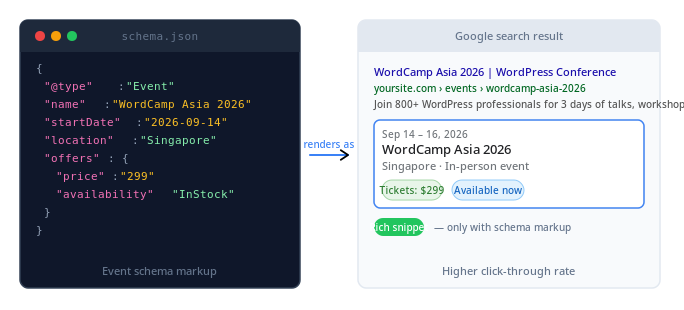
If there is one technical SEO element that event websites absolutely cannot skip, it is Event Schema markup. Structured data tells search engines the precise details of your event — name, date, time, location, ticket price, and organizer — in a format they can display directly in search results as rich snippets.
When properly implemented, your event can appear with its date and venue displayed right on the Google results page, significantly increasing click-through rates. WP Event Manager supports integrations with schema plugins and structured data tools, making this implementation more accessible than it would be on a custom-built site.
Without schema markup, you are invisible to Google's event-specific search features, including the dedicated event listings that appear above regular results for searches like "events in [city] this weekend."
4. Technical SEO: Speed, Mobile, and Crawlability
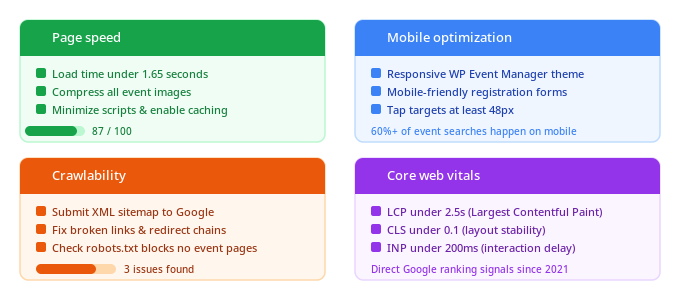
Search engines in 2026 weigh user experience signals more heavily than at any prior point. This makes technical performance a direct ranking factor, not just a nice-to-have.
Page Speed is critical. The average load time for a first-page Google result is around 1.65 seconds. A one-second delay in load time can reduce conversions by roughly 7%. For event websites, where registration often happens on impulse, slow load times are doubly damaging — they hurt both rankings and sign-ups simultaneously. Use tools like Google PageSpeed Insights or GTmetrix to identify bottlenecks, and work to compress images, minimize unnecessary scripts, and leverage browser caching.
Mobile Optimization is non-negotiable. Over 60% of event-related searches happen on mobile devices. If your registration page is difficult to navigate on a phone, you are losing attendees before they even engage. Ensure your WP Event Manager theme is fully responsive and that registration forms function smoothly on small screens.
Crawlability ensures that search engines can access and index your event pages. Regularly audit your site with tools like Screaming Frog or Google Search Console to identify broken links, duplicate content, missing canonical tags, and pages accidentally blocked by your robots.txt file. Submit an updated XML sitemap whenever you publish new event listings.
5. Content Marketing: Build Authority Around Your Events
A single event listing page, no matter how well optimized, has limited SEO reach on its own. The most effective event websites build topical authority by surrounding their core listings with a network of supporting content.
A consistent blog is one of the most powerful drivers of organic traffic for event websites. Publishing articles that address what your target audience is searching for — well before the event date — gives you a head start in the rankings. Effective content categories include:
- Speaker spotlights and interviews that rank for the speaker's name.
- Industry trend articles aligned with your event's theme.
- Practical guides relevant to your audience, such as "What to Expect at Your First Developer Conference."
- Location-specific posts like "Top Venues for Corporate Events in [City]."
- Post-event recaps with photos, highlights, and key takeaways.
Each of these pieces should link back to your main event registration page, building internal authority while providing genuine value to readers.
6. Local SEO: Capture Attendees in Your Geography
For events with a physical venue, local search optimization can be transformative. Start by setting up and fully optimizing a Google Business Profile for your organization. A well-maintained profile — complete with your event category, address, contact details, photos, and regular updates — improves your visibility in local map pack results and "near me" searches.
Consistency matters: ensure that your business name, address, and phone number (NAP) are identical across your website, Google Business Profile, and any third-party event directories where you are listed. Inconsistencies confuse search engines and dilute your local authority.
Encourage past attendees to leave reviews on your Google profile. Positive reviews improve your local ranking and increase the trust of first-time visitors, evaluating whether to register.
7. Link Building: Earn External Authority
Backlinks from reputable, relevant websites remain one of the strongest signals of authority in Google's ranking algorithm. For event websites, some of the most effective link-building opportunities include:
- Getting listed in industry event directories and calendars
- Asking speakers and sponsors to link to your event page from their own websites
- Pitching event coverage to industry publications and local media
- Building relationships with complementary organizations whose audiences overlap with yours
Quality always outweighs quantity in link building. A single link from a well-regarded industry publication is worth more than dozens of links from low-authority directories.
8. Don't Delete Your Past Event Pages
One of the most common and costly mistakes event organizers make is taking down their event pages after the event concludes. Those pages have accumulated search authority, backlinks, and indexed content that took months to build. Deleting them means starting from zero every year.
Instead, update past event pages with highlights, photo galleries, session recordings, and a "Save the Date" announcement for the next edition. This preserves your SEO equity, gives late visitors something valuable to engage with, and gives you a running head start the moment you begin promoting the next event.
Start Early, Stay Consistent
SEO is not a switch you flip two weeks before your event. Competitive keywords take time to rank for, and the window between launching a campaign and earning meaningful organic traffic can be several months. The most successful event websites start their SEO groundwork at least six months before the event date, building content and authority steadily throughout.
With WP Event Manager providing the technical foundation for your event listings, you are already in a strong position. Layer on the strategies in this guide — structured data, optimized pages, supporting content, local SEO, and link building — and you will have a search presence that fills seats reliably, year after year, without paying for every click.
About the Author